
Delving Deeper into The Count of Monte Cristo
I finished reading The Count of Monte Cristo this week and here reflect on the book, the themes, the movie adaptation, the publication history, and its legacy.

The book:
The Count of Monte Cristo is an adventure novel written by French author Alexandre Dumas (père) completed in 1844. It is one of the author's most popular works, along with The Three Musketeers. The story follows Edmond Dantès, a young sailor wrongfully imprisoned in the Château d'If for 14 years. After escaping, he uses the fortune he has been given to exact revenge on those who wronged him and contribute to many charitable endeavors.
Many of the reviews and adaptations focus on just the vengeance, which admittedly is the main theme of the novel, but neglect to comment on the depth of the storytelling, the nuances of the large cast of characters, the commentary on politics and manners of the time, the psychology inherent in both the crimes and the justice, and how everything done affected the next generation. No one was shown as a pure saint or sinner.
Edmond Dantès develops during the novel from a 19-year-old kind, trusting, talented young man into an almost 40-year-old man who has grappled with injustice, revenge, loss, sanity, charity, education, and is finally at the end of the story able to put it all behind him and start his life anew.
The themes:
The Count of Monte Cristo explores a variety of themes, including revenge, justice, redemption, and the power of money. The novel has been praised for its complex plot, vivid characters, and suspenseful story. But what stood out to me the most is the idea that what is done in secret will be made public, and one’s deeds will set the course for the future of the individual and the family and community. Three men conspired to falsely accuse Edmond of treason. A fourth man correctly judges him innocent, but then quietly hides him away in the worst dungeon of that time to protect his father’s involvement and his own career aspirations.
Through the course of the story, readers learn that the initial lapse in integrity by each of the men to achieve their ambitions sets the course for more and more severe crimes. Believing they have gotten away with it, they continue in their arrogance that affects not only their careers but also their business and familial relationships. Their spouses and children are affected, both by how they are treated by these men, and later by the community.
There is also the concept of how vengeance and revenge belong to God, and although Dantès believed himself to be saved by God and a tool of vengeance used by God, he ignored his mentor and priest’s admonishment to leave that to God. By being so focused on exacting revenge and righting the wrongs committed by his four enemies, he gave up the chance to do even more good and charity, and to truly enjoy his life and the relationships that he had the opportunity to build. How much more could he have learned, built, experienced, and positively impacted his community and society if he had used his fortune, education, talents, and time for endeavors more in line with what the Abbe Feria recommended?
The movie:
The Count of Monte Cristo has been adapted into numerous movies, including a silent film as early as 1908, a French film in 1929, a made-for-TV film in 1975 that was nominated for two primetime Emmys, and a $35M budget Hollywood movie in 2002 that grossed over $75M. The most recent adaptation, a Russian film, was released in 2018.
The day after I finished the book, I watched the 1975 version of the movie starring Richard Chamberlain. What a task the writers and directors faced telling that epic story in one hour and forty-five minutes! Many of the characters and storylines were abridged or left out. The ending was changed, as it had to be based on the other changes made. Watching the movie almost fifty years after it was made was interesting, as it was definitely a production of its time, and felt almost like a soap opera. But to the credit of the filmmakers, they did get a lot of content into that short run time.
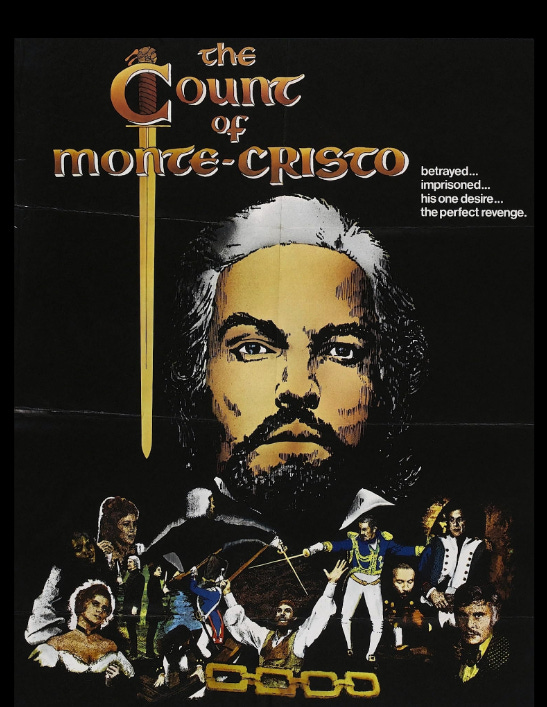
My biggest concern is that those who only watch the movie versions will get the gist of the main plot and only some of the nuance, subtlety, and depth that the novel provides. I know that’s a reality for most movies adapted from books, but there were four main plot lines and relevant characters plus many more subplots and minor characters, that there is no way a single movie could capture the brilliance of the novel, nor the original author. After watching the movie, I told my husband it felt like a Cliff Notes version of a fourth of the book. I do intend to watch the 2002 movie, just for a comparison.
The publication:
The Count of Monte Cristo was first published in serial form in a French newspaper from 1844 to 1846. It was then published in book form in 1846. The novel has been translated into all the most spoken languages of the world, in complete and abridged forms.
What fascinated me was that I just learned that William Harrison Ainsworth, British bestselling author of his era and owner of Ainsworth’s Magazine, and his cousin W. Francis Ainsworth, completed the first English translations of The Count of Monte Cristo and published it in serial form in 1845-1846 in his magazine. It was later translated again and published in book form.
This excites me because W. Harrison Ainsworth was the subject of my Master’s thesis. I knew that he had collaborated with other publishers, including Edgar Allen Poe in Philadelphia. There were several Victorian-era authors and publishers who worked both collaboratively and competitively to beta test stories in newspapers and magazines, to critique, and to revise in order to create the many classics that have stood the test of time.
It makes me wonder if our rush to publish, and the concept of starving artists working in solitude, has hurt our literary offerings in our current world. Many authors today do take advantage of critique groups and beta readers prior to publication, but many more do not. Dumas was another author who never gained the recognition he deserved during his lifetime. He was a lawyer, a playwright, and part of the group of writers who founded the Romantic Period in literature.
The legacy:
The Count of Monte Cristo is considered one of the greatest novels ever written. It has been adapted into numerous other works of art, including plays, operas, and ballets. The novel has also inspired many films and television shows.
As a writer myself, and a lover of biographies and researching the writing process of successful authors, I am struck by the fact that most of the successful and classic novelists did not depend solely upon their writing for their survival. They had jobs, careers, and connections. These are things that also inspired and influenced their stories. Dumas had access to the royal courts of France, and the best and worst of Parisian life, as well as his father being the son of an aristocrat and his black slave. Could this story have been written by anyone else? I doubt it. The personal history, education, and experience that Dumas had were essential to creating and telling the story of The Count of Monte Cristo.
This novel has not only spawned a multitude of adaptations in multiple mediums, but the work of Dumas, one French author who never realized what a success he was, inspired other creatives, and provided enjoyment, education, and jobs for an untold number of people around the world for almost 200 years.
Whether or not you have read the novel, I imagine you know the gist of the story. Perhaps you have seen the movie or even played Three-card Monte, a card game made popular after the publication of the novel, in which the dealer moves the three cards (representing the three enemies of Dantès) and you try to keep your eye on one of the cards, just as it was nearly impossible to keep up with all the ways Dantès manipulated the stories and situations in order to avenge himself against those who sent him to prison and destroyed his life.
So tell me, have you read the novel? What did you think? And have you considered all the ways this one author and one book has influenced our culture today? Had I known all this while working on my thesis, I feel certain it would have taken a very different direction.
I love the Count of Monte Cristo, though it's been a while since my last read. Interesting to read your thoughts on it!